
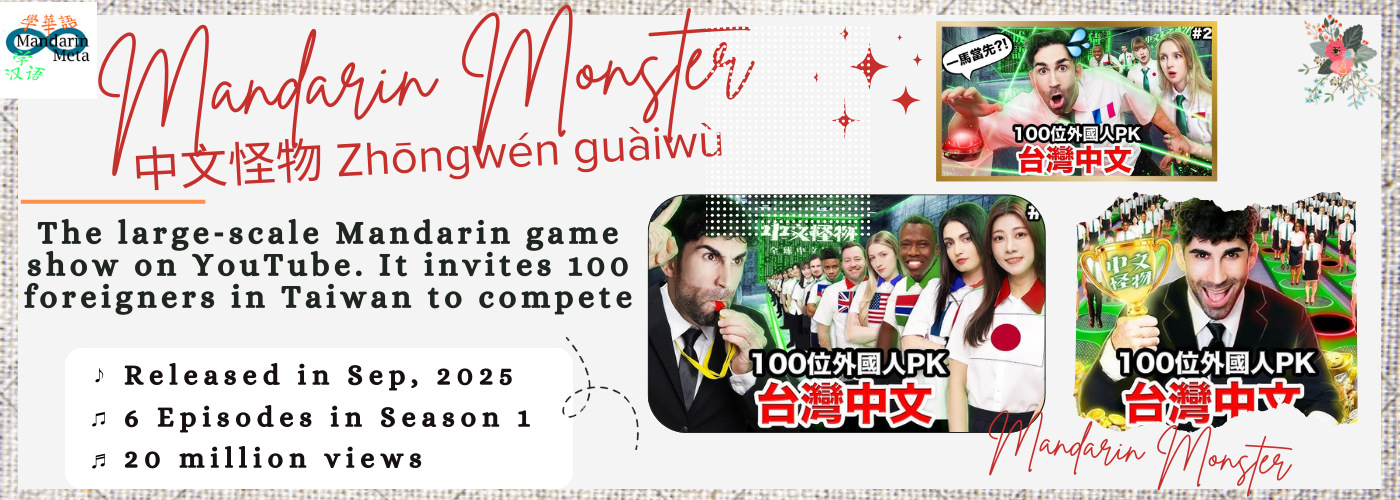
“Mandarin Monster” is a large‑scale Mandarin game show on YouTube. It invites 100 foreigners in Taiwan to compete in pronunciation, vocabulary, listening, and improvisation challenges to find the so‑called “Mandarin Monster” – the contestant with the strongest Mandarin skills.
“The Mandarin Monster” (中文怪物) is a live-action reality competition show created by the popular YouTuber Ku’s Dream (酷的夢 Ku’s Dream). The show gathers 100 foreigners living in Taiwan to compete in a series of challenges designed to test who has the strongest Chinese language skills.
The 100 non-native Chinese speakers from various regions, including Europe, America, Asia, and Africa.
The contestants included several foreign YouTubers and celebrities well-known in Taiwan, such as:
- 早川小百合 Sayuri (小百合Xiǎo bái hé) from Japan
- Harrison Flagler (海瑞森Hǎi ruì sēn) from the USA
- Tristan Hilderbrand (崔璀璨 Cuī cuǐcàn) from the USA
- 波蘭Anna from Poland
💡 What is the Show About?
- Concept: The Mandarin Monster is a survival/competition reality show centered entirely on the Mandarin language.
- Challenges: The competitive stages cover a wide range of linguistic skills, from tones and pronunciation, character creation (造字), and word meanings (詞義), to listening comprehension and impromptu expression.
- Prize: Contestants hail from all over the world. The ultimate winner receives a grand prize of approximately NT$300,000 (roughly US$9,500) and earns the title of “The Mandarin Monster.”
⚔️ Key Stages and Challenges
The competition is structured into several phases:
- Phase 1: Tones (Episode 1)
- Focus: Identifying correct tone combinations in easily confusing phrases (e.g., “卡比寶寶吃水餃” – even confusing for native speakers). The field is cut to 50.
- Phase 2: Comprehension & Culture (Episodes 2-3)
- Focus: Team challenges involving listening comprehension, contextual judgment (like the cultural metaphor of “中獎” meaning pregnancy), and logic puzzles. A “resurrection round” brings back five eliminated players.
- Phase 3: The Masters’ Challenge (Episodes 4-5)
- Focus: The remaining 30 contestants face off directly against four “Taiwanese Masters” (高手), including veteran news anchor Shen Chun-Hua(沈春華) and comedian Brian Tseng(曾伯恩). Challenges primarily test listening to rapid or slurred speech (e.g., fast commercial lines).
- Elimination: The elimination process involves a strategic twist where team rankings determine who is safe, and mid-ranked teams must vote internally to eliminate members.
- Phase 4: Grand Finale (Episode 6)
- Rounds: The final five participants compete in the “Monster Stage” against specialized challenge masters:
- Round 1: Distinguishing children’s choir pronunciation.
- Round 2: Comprehending rapid-fire night market vendor calls (叫賣哥).
- Round 3: Difficult listening comprehension of rap lyrics (Night Owls夜貓組-Leo王與春艷).
- Rounds: The final five participants compete in the “Monster Stage” against specialized challenge masters:
🐲 Why “The Mandarin Monster”?
The term “Monster” (怪物) in this context is used positively.
- It means someone is so exceptionally good at Chinese that they are “fierce and impressive like a monster.” It’s a catchy name that emphasizes the challenge.
- “Monster” also represents the diversity of linguistic expertise among the contestants. Some excel in precise pronunciation, others in quick wit and response speed, and others in deep cultural knowledge.
💯 Why is it Worth Watching?
- Engaging Content: The challenges effectively blend games and language learning, creating moments of great comedy while genuinely making viewers realize the difficulty and fascinating aspects of the Chinese language.
- High Production Value: The show has a fast pace and high production quality, often described as having the look and feel of a “mini-Netflix reality show.”
- Star Power: The judges and guest commentators are highly engaging and well-known, making the series highly addictive and easy to watch episode after episode.
Mandarin Meta is a platform for Mandarin language learners to learn in easy and fun ways, and we teach daily-use sentences, phrases, conversation, grammar, vocabulary, pronunciation, speaking, Mandarin-speaking TV/Music channels, and culture.
📌Send the email to studentsuccess@mandarinmeta.com
📌Click! Trial Online Lesson: https://preply.com/en/tutor/1373388
I will reply to you as soon as possible. Thanks!
 🚀🚀Mandarin Meta 華語元宇宙